Compliance Solutions
Email Compliance Solution for
Regulated Organizations
SafeMailer is an email compliance solution that encrypts messages and attachments so regulated organizations can send sensitive data by email under HIPAA, GDPR, CMMC, DFARS, NIST SP 800-171, ITAR, CJIS, FERPA, ISO 27001, the FTC Safeguards Rule, FINRA, GLBA, PCI DSS and SOX. SafeMailer runs inside Gmail and Outlook with no plugin, no MX record change and no recipient registration. Recipients open a protected message by verifying their identity with the Google or Microsoft account they already use. SafeMailer holds SOC 2 Type II and ISO 27001 certification, is priced per sender instead of per mailbox, and signs a Business Associate Agreement on every plan, including the free one.
What an Email Compliance Solution Has to Do
Almost every regulation that touches email asks for the same four things in different language. Protect the data so an unauthorized reader cannot make sense of it. Control who is allowed to open it. Prove afterwards that both of those things happened. Keep the record for as long as the rule says. An email compliance solution is any platform that takes one or more of those jobs off your team and does it consistently, rather than leaving it to whoever happens to be sending the message.
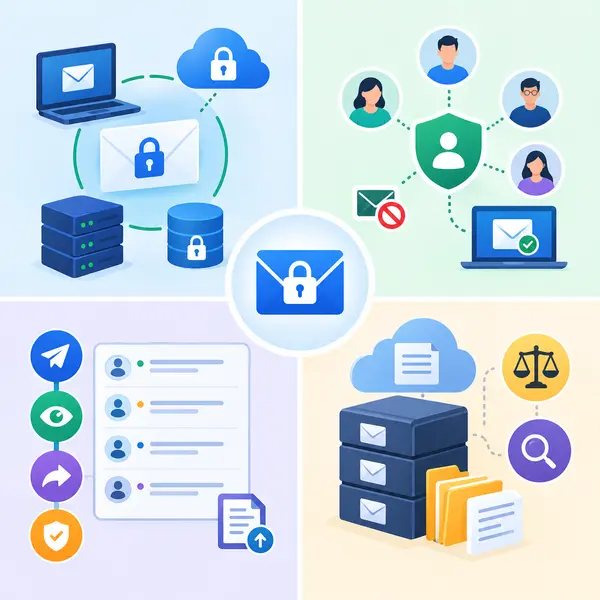
SafeMailer covers the first three. Message bodies and attachments are encrypted with AES-256-GCM at rest and TLS 1.3 in transit, so protected health information, personally identifiable information and controlled unclassified information stay unreadable in transit and in storage. Access is tied to a verified identity rather than to whoever holds the inbox, and the sender can revoke access after delivery or set a message to expire after a single view. Every send, open, forward and revocation is written to an audit trail you can export when an assessor asks how a specific record was handled.
The part that trips teams up is the fourth job. Retention, legal hold and eDiscovery belong to an archiving platform, not to an encryption platform, and buying one when you need the other is the most common mistake in this category. It is worth reading how SafeMailer encrypts and delivers email before you decide which gap you are actually filling.
Comprehensive Compliance Coverage
SafeMailer applies one encryption and access control layer across every framework your organization answers to, so a compliance team is not maintaining a separate tool per regulation.
Data Protection
SafeMailer encrypts message content and attachments with AES-256-GCM at rest and TLS 1.3 in transit, which is the safeguard most data protection rules point to when they ask for appropriate technical measures.
Audit Ready
SafeMailer logs delivery, recipient verification, opens, forwards and revocations, giving you the message-level evidence an auditor asks for instead of a mail server log that stops at the boundary.
Multi-Framework
A healthcare group under HIPAA is often under state privacy law and the FTC Safeguards Rule at the same time. SafeMailer satisfies the overlapping email requirements once rather than three times.
Framework Coverage at a Glance
Two words do a lot of work in this category and buyers confuse them constantly. Certified means an accredited body audited the platform and issued a certificate. Supported means the platform provides the controls the rule requires, but the rule has no certifying body, so no vendor can hold a certificate for it. SafeMailer is certified for SOC 2 Type II and ISO 27001. Everything else in the table below is supported, and any vendor claiming otherwise is describing something that does not exist.
| Framework | Email obligation it creates | SafeMailer control | Status |
|---|---|---|---|
| HIPAA | Protect ePHI in transit and at rest, control access, log disclosures | Encryption, identity verification, audit trail, signed BAA | Supported |
| GDPR | Appropriate technical measures for personal data, cross border safeguards | Encryption, access revocation, data minimization by message | Supported |
| CMMC Level 2 | Protect CUI in nonfederal systems against unauthorized disclosure | Encryption, least privilege access, verification records | Supported |
| DFARS 252.204-7012 | Adequate security for covered defense information sent by email | Encryption, access control, incident evidence trail | Supported |
| NIST SP 800-171 | Access control, audit and accountability, system and comms protection | Control mapping across three of the fourteen families | Supported |
| ITAR | Prevent access to export controlled technical data by foreign persons | Recipient identity verification, revocation after delivery | Supported |
| CJIS | Protect criminal justice information, enforce advanced authentication | Encryption, multi factor recipient verification, logging | Supported |
| FERPA | Limit disclosure of student education records, record disclosures | Encryption, per message access control, disclosure log | Supported |
| FTC Safeguards Rule | Encrypt customer information in transit over external networks | Encryption applied by default to every protected send | Supported |
| GLBA | Safeguard nonpublic personal financial information | Encryption, access control, auditable delivery record | Supported |
| PCI DSS | Never send unprotected primary account numbers over open networks | Encryption of message body and attachments before transmission | Supported |
| FINRA and SOX | Protect and evidence business communications | Encryption plus exportable audit trail for the send record | Supported |
| ISO 27001 | Cryptographic controls, access control, communications security | Certified information security management system | Certified |
| SOC 2 Type II | Independent attestation of security controls over a period | Report available under NDA on request | Certified |
Healthcare and Protected Health Information
The HIPAA Security Rule does not ban email. It asks a covered entity to decide whether encryption is reasonable and appropriate, and in 2026 there is no defensible argument that sending unprotected patient data across the open internet clears that bar. SafeMailer encrypts the message and its attachments, verifies the recipient before the content is released, and records the disclosure so the practice can answer a patient access request or an Office for Civil Rights inquiry with a specific record rather than a guess.

HIPAA Requirements Met:

GDPR Protections:
Personal Data and Cross Border Privacy
Article 32 of the GDPR names encryption of personal data as an example of an appropriate technical measure, and Article 34 lets a controller skip individual breach notification when the exposed data was rendered unintelligible. That second point is the one most teams miss. If a message is intercepted and it was encrypted with SafeMailer, the calculus of what you owe the supervisory authority and the data subject changes materially.
Financial Services and Customer Information
A single financial firm is usually answering to four rulebooks at once, and all four say something about email. SOX cares about the integrity of financial reporting communications. GLBA covers nonpublic personal information. PCI DSS is blunt about never sending an unprotected primary account number across an open network. FINRA expects supervised, retrievable business communications. SafeMailer addresses the protection and evidence side of all four with one control set applied at send time.
SOX
SafeMailer protects financial reporting correspondence and produces a tamper evident record of who received it and when.
Learn More about SOX Financial Services RegulationsGLBA
SafeMailer encrypts customer financial information and restricts access to a verified recipient rather than an inbox.
Learn More about GLBA Financial Services RegulationsPCI DSS
SafeMailer encrypts message content and attachments before transmission, which is what Requirement 4 asks for on open networks.
Learn More about PCI DSS Financial Services RegulationsFINRA
SafeMailer secures the communication and exports the send record. Retention and supervision remain the job of your archiving platform.
Read the detail on financial services email complianceFTC Safeguards Rule
The amended Safeguards Rule pulled tax preparers, mortgage brokers, auto dealers, collection agencies, investment advisers and a long list of other non-bank financial institutions into scope, and it is explicit about encrypting customer information in transit over external networks. Most of the businesses now covered have no security team and no budget line for one, which is the practical problem the rule created. SafeMailer gives them the encryption, access control and delivery evidence the rule asks for without a deployment project or a change to their mail setup, and the free plan lets a small firm start protecting client information the same afternoon it discovers it is in scope.
Defense, Export Control and Public Sector
Controlled unclassified information moves through email constantly in the defense supply chain, and it is where subcontractors most often fail an assessment. The problem is rarely the network. It is a drawing or a statement of work sitting unprotected in a thread that has been forwarded twice. SafeMailer keeps the protection attached to the message instead of to the perimeter.
CMMC and DFARS
SafeMailer supports CMMC Level 2 practices and the DFARS 252.204-7012 requirement for adequate security by encrypting CUI, limiting access to verified recipients and preserving an evidence trail for incident reporting.
See how SafeMailer maps to CMMC and DFARS email requirementsNIST SP 800-171
SafeMailer contributes controls across three of the fourteen families in NIST SP 800-171: Access Control, Audit and Accountability, and System and Communications Protection. SafeMailer does not claim to satisfy all fourteen, and no email platform does.
ITAR
Under ITAR, letting a foreign person view export controlled technical data is a deemed export whether or not anything crosses a border. SafeMailer ties access to a verified identity and lets a sender revoke a message after it has been delivered, which turns a misdirected email from a disclosure into a blocked attempt.
Read more on ITAR export controlled emailCJIS
The CJIS Security Policy requires advanced authentication before anyone reaches criminal justice information from outside a physically secure location, and it applies to the prosecutor, the contracted forensics lab and the county IT vendor as much as it applies to the agency itself. That outside-the-perimeter case is exactly where email is used and exactly where it is weakest. SafeMailer applies encryption and multi factor recipient verification to every protected message, releases the content only after that verification succeeds, and logs the access so the agency can show an auditor which record left the building and who opened it.
See the requirements for CJIS criminal justice email securityFERPA
Student education records travel between registrars, counselors, parents, district offices and third party service providers by email every day, and school staff are rarely security trained. FERPA is less concerned with the transport than with disclosure: who received the record, whether they were entitled to it, and whether the institution can show that. SafeMailer encrypts the record, limits access to a verified recipient rather than an inbox that may be shared, and writes each disclosure to a log the district can produce when a parent or an auditor asks who has seen a file.
Read about FERPA student record protectionInformation Security Management and ISO 27001
SafeMailer is one of the few email encryption platforms that is itself ISO 27001 certified rather than merely aligned to the standard. That matters during vendor due diligence, because a certified supplier shortens the assessment your own auditor runs on your supply chain. SafeMailer supports the cryptographic and communications controls in Annex A and provides the operational evidence your information security management system needs to demonstrate them.
ISO 27001 Control Domains:
What SafeMailer Does Not Do
Vendors in this category tend to answer every requirement with yes, which is how buyers end up with a tool that fails the audit it was bought for. Here is the honest boundary.
Being specific about scope is not a weakness. It is the difference between a control an assessor accepts and a claim an assessor has to unpick.
Why Compliance Teams Choose SafeMailer
No Deployment Project
SafeMailer works inside Gmail and Outlook with no plugin, no MX record change and no mail routing change. A compliance officer can start using it without opening a ticket with IT, which is why adoption does not stall after the pilot.
Recipients Do Not Register
Most secure email fails at the recipient. Portals with new passwords get abandoned, and staff quietly go back to unprotected attachments. SafeMailer recipients verify with the Google or Microsoft account they already have, so protected messages actually get opened.
Priced Per Sender
Only a fraction of an organization sends regulated data. SafeMailer charges for the people who send protected email rather than every mailbox in the directory, so a fifty person clinic pays for the five people handling records. You can check the numbers on the SafeMailer plans and pricing page.
Common Questions About Email Compliance
SafeMailer supports HIPAA, CMMC Level 2 and GDPR from a single platform. SafeMailer encrypts message bodies and attachments with AES-256-GCM at rest and TLS 1.3 in transit, releases content only to a recipient who has verified identity through a Google or Microsoft account, writes every access to an audit trail, and signs a Business Associate Agreement on every plan, including the free plan. SafeMailer itself holds SOC 2 Type II and ISO 27001 certification. When you are comparing options, check whether a vendor covers all three frameworks with one control set or asks you to license a separate module per regulation.
SafeMailer serves healthcare, defense contracting, aerospace, government, finance, legal and education. Each sector applies a different rulebook to the same underlying problem, which is sensitive data leaving the organization through email. SafeMailer applies one encryption and access control layer across all of them, so a defense subcontractor protecting CUI and a clinic protecting patient records are using the same platform configured differently rather than two separate products.
SafeMailer integrates with Gmail and Outlook without a plugin or an MX record change, so insurance teams send encrypted policy documents, claims files and customer financial information from the mailbox they already use. SafeMailer also exposes a REST API, which lets a policy administration or claims system send a protected message programmatically. Insurance workflows usually fall under the FTC Safeguards Rule and GLBA, and both are covered by the same SafeMailer controls.
This question contains a trap worth naming. HIPAA and GDPR have no certifying body, so no email platform holds a HIPAA certificate or a GDPR certificate, and any vendor advertising one is describing something that does not exist. What a platform can hold is an independent attestation of its own security. SafeMailer holds SOC 2 Type II and ISO 27001 certification and supports HIPAA, GDPR, CMMC, DFARS, ITAR, CJIS, FERPA, the FTC Safeguards Rule, FINRA, GLBA, PCI DSS and SOX through encryption, access control, audit logging and a signed BAA.
Partly, and it is worth being precise about which part. SafeMailer automates the evidence layer. Every protected send, recipient verification, open, forward and revocation is captured and exportable, which removes the manual reconstruction that usually eats the first week of an audit. SafeMailer does not generate a finished HIPAA risk analysis or a GDPR record of processing activities, because those documents describe your whole organization and not just its email. What SafeMailer gives you is the email evidence those documents have to reference.
Standard Gmail or Outlook mail encrypts the connection between mail servers when the receiving server supports it and stops there. It does not verify who opens the message, does not let you withdraw access after a misdirected send, and does not produce a per message disclosure record. That is enough for ordinary correspondence and not enough for regulated data. SafeMailer sits on top of the same mailbox and adds the message-level protection, identity verification and audit trail that HIPAA and GDPR expect for sensitive content.
Yes. SafeMailer signs a BAA on every plan, and the free plan is not excluded. A covered entity can execute the agreement, send ten encrypted emails a month with attachments up to 100 MB and evaluate SafeMailer against its own risk assessment without a purchase. Most vendors in this category put the BAA behind a paid tier or a sales conversation, which is what makes a genuine compliance pilot difficult to run.
An email compliance solution protects the message and controls who can open it. Email archiving software preserves the message so it can be produced years later in an audit or a legal proceeding. They answer different regulatory obligations, and neither substitutes for the other. SafeMailer is on the protection and access control side. An organization under recordkeeping rules such as FINRA Rule 3110 or SEC Rule 17a-4 needs both, and buying only the archive is how regulated data ends up transmitted unprotected in the first place.
Start Sending Compliant Email This Week
You do not need a purchase order to find out whether SafeMailer fits your control environment. The free plan includes ten encrypted emails a month, attachments up to 100 MB and a signed Business Associate Agreement, which means a covered entity can execute the BAA, send a real protected message and test it against its own risk assessment before anyone talks about budget. Most teams know within a week.