Government Solutions
Email Security for Government Agencies and Public Sector
SafeMailer adds encryption, verified recipient access, and full audit logging to the Gmail and Outlook accounts your staff already use. No gateway, no MX record change, no migration. Send your first protected message today on the free plan.
Email security for government agencies is the protection of public sector email through encryption, verified recipient identity, sender-retained access controls, and audit logging. SafeMailer delivers all four inside existing Gmail and Outlook accounts, encrypting message content and attachments with AES-256-GCM at rest and TLS 1.3 in transit, under a zero-trust key management model.
Public sector teams move sensitive material by email every hour of the working day. Citizen records, case files, procurement documents, inter-agency coordination, and controlled unclassified information all travel through the one channel attackers probe first. Most of that traffic is protected only while it moves between mail servers. The moment it lands, it sits readable in a contractor mailbox, a partner agency inbox, or a personal account, often for years.
SafeMailer closes that window. Protection attaches to the message rather than to the network around it, so a benefits record stays encrypted after delivery, still access controlled, and still revocable by the agency that sent it. There is nothing to install, no mail routing to rebuild, and no portal that citizens or partner agencies are forced to register for. Any department can start on the free plan today, at no cost, without a purchase order and without waiting on a procurement cycle.
Government Email Security Software That Runs Inside Existing Agency Mailboxes
Most government email security software asks an agency to rebuild something before it protects a single message. Secure email gateways need MX record changes and mail routing work. Client-side plugins need endpoint deployment across every workstation, plus the helpdesk queue that follows. Government cloud tenants need a migration budget and a procurement cycle measured in quarters.
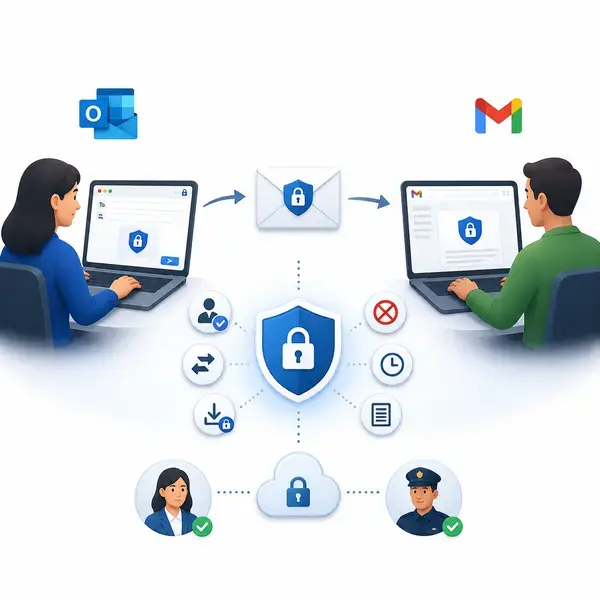
SafeMailer takes the opposite path. It runs as browser-based software inside Microsoft Outlook and Google Gmail, so a caseworker writes a message the way they always have and chooses to send it protected. Encryption, recipient verification, forwarding and download controls, access revocation, and audit logging then apply to that message automatically.
Recipients open protected mail by verifying with the Google or Microsoft account they already hold. That removes registration screens, forgotten passwords, and the support calls that follow whenever a partner agency is handed a new portal login. For an IT team of two people running a county network, that difference decides whether a security tool survives its first month.
Deployment is measured in minutes rather than quarters. A department can validate the whole workflow, including what the recipient sees and what the audit record captures, before anyone drafts a requisition. The step-by-step encrypted email workflow shows exactly what a protected message looks like from both sides.
Email Security for Government Agencies by Sector
Different parts of government carry different risk profiles, different oversight bodies, and different data classifications. A county prosecutor sharing discovery files, a prime contractor moving technical data down a supply chain, and an analyst coordinating between agencies all need protection, but the controls each one has to evidence are not the same. A single blanket policy fails all three. SafeMailer configures per team and per message, so each group gets the controls its own assessors ask about without forcing the rest of the agency onto the same restrictive settings.
Defense
Defense organizations and their supplier networks use SafeMailer to move controlled unclassified information without leaving it readable in unprotected mailboxes further down the chain. Senders keep per message control over whether a recipient can forward or download, and every access event is written to a record an assessor can review. See the defense contractor email security solutions built around CMMC and CUI workflows.
Learn More about Defense SolutionsIntelligence
Analysts and cleared support staff use SafeMailer to coordinate across organizational boundaries while sensitive material stays under the control of the originating agency. Access can be withdrawn after delivery if a distribution list turns out to be wrong or a recipient changes role, which ordinary email cannot do once a message has left the server. Identity verification confirms that the person opening a message is the intended recipient rather than anyone who happens to have mailbox access. Audit records answer the question every inspector general eventually asks, which is who opened what and when. Review the inter-agency intelligence email solutions designed for cross-boundary sharing.
Learn More about Intelligence SolutionsState and Local
State departments, counties, municipalities, school districts, and law enforcement agencies use SafeMailer to protect citizen data moving between departments and to exchange records with courts, prosecutors, and neighboring jurisdictions. Public records duties, state breach notification statutes, and CJIS requirements all land on the same inbox, and in most local authorities nobody is assigned to manage any of it full-time. Because SafeMailer runs on mailboxes already in place, a small IT team can roll it out without a project plan or a line item in next year's budget. Smaller offices routinely begin on the free plan and upgrade only when volume justifies it. See the municipal and law enforcement email solutions for state and local workflows.
Learn More about State and Local SolutionsGovernment-Grade Secure Communications That Fit Existing Workflows
Agencies searching for government-grade secure communications are almost never looking for a new email system. They are looking for stronger protection on the system they already run, because replacing it means retraining thousands of staff, rewriting internal procedures, and absorbing a migration nobody has funded. That single constraint is why so many secure messaging projects die at the business case stage.
SafeMailer answers the requirement without the disruption. Encryption, access control, and logging run on top of the existing mail environment. There is no migration, no second inbox, no separate portal for contractors to learn, and no change to how a caseworker, an analyst, or a clerk sends a message. Security sits inside the message rather than in the perimeter around it, which is exactly where gateway filtering stops working.
What government-grade secure communications require
| Requirement | How SafeMailer Delivers It |
|---|---|
| Strong encryption in transit and at rest | AES-256-GCM protects message content and attachments at rest, with TLS 1.3 in transit, under zero-trust key management |
| Verified recipient identity | Recipients authenticate with an existing Google or Microsoft account before a message opens |
| Sender control after delivery | Forwarding and downloading can be blocked per message, and access can be revoked after sending |
| Audit-ready logging | Every open, access attempt, and revocation is recorded for compliance review and open records handling |
| Works with existing email | Runs inside Microsoft Outlook and Google Gmail with no plugin, no install, and no MX record change |
| Available without a procurement cycle | Free plan includes ten encrypted emails a month, One Time View, and a signed BAA, with no card required |
Secure CUI Email and File Transmission for Government Contractors
Controlled unclassified information is the category most government email actually carries. Technical drawings, program schedules, personnel data, procurement pricing, and law enforcement records are all CUI, and all of it moves by email because that is the channel every recipient already has. The obligation attached to CUI does not stop when the message leaves the agency. It follows the data into the supplier mailbox, the subcontractor laptop, and the shared inbox at the partner authority.
SafeMailer protects CUI email and file transmission in three layers, and each layer keeps working after the message lands. The content and every attachment are encrypted with AES-256-GCM at rest. The recipient has to prove identity with a Google or Microsoft account before anything opens. The sender decides, per message, whether that recipient can forward the message or download the files at all and can withdraw access afterwards if a role changes or a distribution list turns out to be wrong.
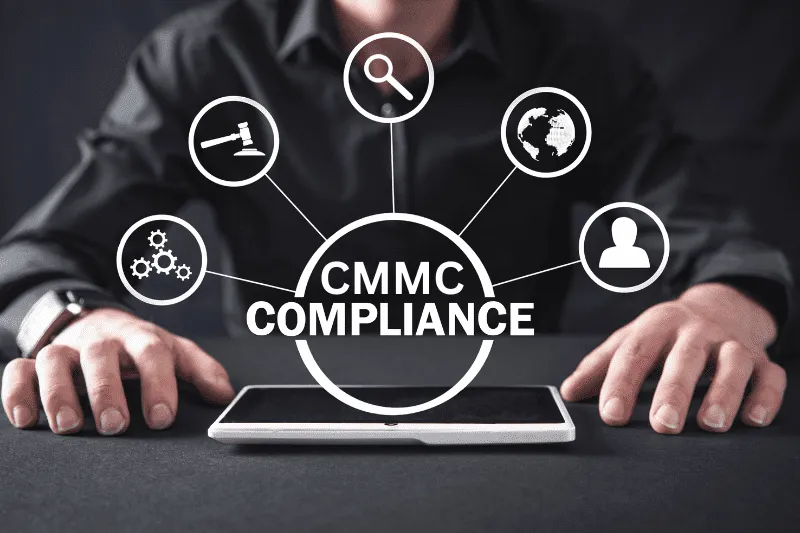
The SafeMailer audit record is where this becomes usable evidence rather than a good intention. Every open, every failed access attempt, and every revocation is logged with a timestamp, which is precisely the artifact an assessor requests when testing access control and accountability practices. Suppliers preparing for assessment can trace the mapping through the CMMC and DFARS email control requirements.
Attachment size is the practical limit most secure file tools hit first. The free plan carries attachments up to 100 MB, the Standard plan up to 2 GB, and the Pro plan has no file size cap, so a full technical data package moves as one protected message instead of being split across a file transfer service with its own separate access controls to manage.
Public Sector Email Security Across Federal, State, and Local Agencies
Public sector email security is usually treated as a perimeter problem. Filter the inbound traffic, authenticate the sending domain, block the phishing attempt. That work matters and most agencies already fund it. What it does not touch is the outbound message that leaves the agency legitimately and then sits unprotected somewhere else for the next several years.
Agencies that adopt SafeMailer usually describe the same trigger. Look at the public sector breaches that reach a headline and a pattern repeats. The data was not stolen in transit. It was sent on purpose, to a recipient who was not equipped to hold it safely, and it stayed there. A procurement file sent to a bidder. A court record sent to a prosecutor's office. A technical drawing sent to a subcontractor who then forwarded it to two more.
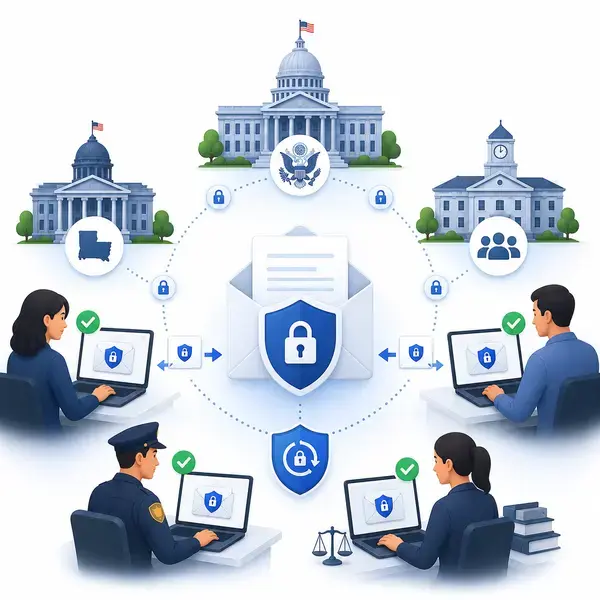
SafeMailer treats that as the actual problem. Because protection is bound to the message, a record sent to a caseworker at another department stays encrypted in that mailbox, still access controlled, and still revocable by the agency that sent it. Federal, state, and local teams describe the same underlying requirement in different vocabulary, which is protection that survives delivery. Agencies handling criminal justice data can review the CJIS email compliance requirements that this maps to directly.
Compliant Government Email Platform Coverage for Public Sector Frameworks
Government email security and compliance are the same conversation. An agency does not adopt encryption because it is good practice. It adopts encryption because an auditor, a state statute, a federal contract clause, or a sponsoring department requires demonstrable protection of a specific data type. SafeMailer is built so the security control and the compliance evidence come out of the same action, which means the audit log that proves access control is also the record an assessor asks for during review.
CMMC, NIST 800-171, and DFARS
Defense contractors and their subcontractors handling controlled unclassified information can map SafeMailer controls to practice requirements across access control, audit and accountability, identification and authentication, and media protection. Encrypted transmission, identity-verified access, and per message forwarding restrictions each produce a logged artifact rather than a policy statement.
CJIS
Criminal justice information transmitted outside a physically secure location has to be encrypted, access controlled, and logged. SafeMailer supports each of those obligations for email carrying criminal justice information between departments, courts, and neighboring agencies, and it does so without requiring the receiving agency to deploy matching software first. That makes it workable across jurisdictions that run different systems.
ITAR and export-controlled data
Technical data subject to export control cannot be exposed to foreign persons, including through cloud services and mail providers that do not restrict access appropriately. Encryption combined with verified recipient identity keeps export-controlled attachments readable only by the intended party, and the audit record shows who opened them. Defense suppliers can confirm the specific handling rules on the ITAR email handling page.
ISO 27001 and SOC 2 Type II
SafeMailer holds ISO 27001 certification and a SOC 2 Type II report. For a government security reviewer these are the two artifacts that let a vendor claim be tested rather than taken on trust, and both are usually requested before a pilot is approved rather than after. ISO 27001 covers how the information security management system is designed, operated, and reviewed. SOC 2 Type II covers whether the stated controls actually held over an audit window rather than on the day of inspection. Between them they answer the two questions a state or federal security officer will put in writing during vendor review, which are whether a control framework exists and whether anyone independently checked that it worked. Review the ISO 27001 information security controls SafeMailer operates under.
Encrypted Email for Government Compared With Gateways, Plugins, and Cloud Tenants
Agencies evaluating secure email land on four approaches. They solve different problems and cost very different amounts of time to put in place. This is the comparison a procurement review will run anyway, so it is worth running it early.
| Approach | Deployment effort | MX change needed | Protects after delivery | Recipient must register | Typical entry cost |
|---|---|---|---|---|---|
| Secure email gateway (Proofpoint, Mimecast, MailRoute) | Weeks to months, mail routing project | Yes | No, filtering stops at the perimeter | No | Annual contract, per mailbox |
| Government cloud tenant (Microsoft 365 GCC High) | Quarters, full tenant migration | Tenant level | Within the tenant boundary only | No | Migration budget plus per-seat licensing |
| Client-side encryption plugin (Virtru, Zix) | Endpoint deployment across every workstation | No | Yes | Sometimes | Annual contract, per user |
| SafeMailer | Minutes, browser based, nothing to install | No | Yes, with revocation after sending | No, verifies with existing Google or Microsoft account | Free plan, then $47.99 per sender per month |
Verified encryption standards rather than marketing language
SafeMailer states the actual cipher rather than describing protection as military grade or bank grade. Message content and attachments are encrypted with AES-256-GCM at rest and TLS 1.3 in transit, backed by SOC 2 Type II and ISO 27001 certification. Security teams evaluating vendors can verify those claims against a certification report instead of accepting a slogan, which is what a procurement review will ask for anyway.
Control that continues after the message is sent
Ordinary email is a one-way door. Once a message is delivered, the sending agency has no further say in what happens to it. SafeMailer keeps that door open. A sender can block forwarding and downloading on a specific message, apply One Time View so the content is readable once and then closed, and revoke access entirely if a recipient leaves a role or a distribution list turns out to be wrong. For an agency subject to public records requests and breach notification duties, that difference is operational rather than theoretical.
No install, no plugin, no migration project
There is no software to install, no plugin to push to endpoints, no MX record to change, and no migration to fund. Staff keep the mailbox they already use, recipients keep the account they already have, and a team can be protecting real messages the same afternoon. If you want to see how SafeMailer stacks up against the tools already on your shortlist, the secure email software comparison breaks it down.
Start Free Government Email Security Without a Procurement Cycle
The reason most agency security projects stall is not the technology. It is that nothing can be tested until money moves, and money does not move until somebody has tested it. SafeMailer breaks that loop. The free plan is a working production plan, not a countdown to a paywall. There is no card required, no expiry date, and no feature stripped out to force an upgrade conversation.
A department gets ten encrypted emails a month, attachments up to 100 MB, One Time View, recipient identity verification, the full audit trail, and a signed business associate agreement. That is enough to send real protected messages to a real partner agency and to show a reviewer exactly what the audit record captures before anyone writes a requirement document. Create a free SafeMailer account and protect your first government message today.
| Plan | Price per sender | Encrypted emails a month | Attachment limit |
|---|---|---|---|
| Free | $0 | 10 | Up to 100 MB |
| Standard | $47.99 a month | 500 | Up to 2 GB |
| Pro | $96.99 a month | 1,000 | No file size limit |
Pricing is per sender rather than per mailbox, so an agency pays only for the people who actually send protected mail. A records clerk who receives protected messages costs nothing. That distinction matters in a department of four hundred where twelve people handle sensitive outbound correspondence.
The budget arithmetic is worth stating plainly. A Standard seat runs under six hundred dollars a year. That sits well below the federal micro-purchase threshold, which means a department head can typically authorize it on a purchase card without a competitive solicitation, without a sole-source justification, and without waiting on the next budget cycle. For a public sector buyer that is often the difference between a tool arriving this month and a tool arriving next fiscal year. Confirm current figures and annual billing options on the SafeMailer pricing plans page.
Public Sector Teams That Rely on SafeMailer
Federal agencies, defense contractors and their subcontractors, intelligence support units, state government departments, county offices, municipalities, school districts, and law enforcement agencies use SafeMailer to protect email carrying sensitive and controlled unclassified information. The common thread is not size or budget. It is a legal duty to protect a specific data type, an inbox that already works, and no appetite whatsoever to replace it.
Government Email Security Questions Agencies Ask Most
What is email security for government agencies?
Email security for government agencies is the protection of public sector email through encryption, verified recipient access, sender-retained controls, and audit logging, so citizen records, controlled unclassified information, and inter-agency messages cannot be read by anyone outside the intended audience. SafeMailer adds all four inside existing Gmail and Outlook accounts without replacing the mail system.
Is standard government email already encrypted and compliant?
Not on its own. Most agency email relies on transport layer encryption, which protects messages between mail servers but leaves content readable at rest and after delivery. Compliance frameworks including CJIS, NIST 800-171, and DFARS expect protection of the data itself, along with access control and logging. Government-grade secure communications require those layers on top of the mail system, which is what SafeMailer adds inside existing Gmail and Outlook accounts.
What is the best email security software for a government agency?
The right choice depends on whether the agency can absorb infrastructure change. Gateway products filter inbound threats but need MX record changes and stop protecting a message once it is delivered. Government cloud tenants provide a compliant boundary at significant migration cost. SafeMailer suits agencies that need protection on outbound sensitive email quickly and cannot fund a migration, and it can be tested free before any purchase decision.
How do I choose government email software that meets compliance standards?
Test four things. Confirm the named cipher rather than a marketing phrase. Confirm that protection survives delivery instead of stopping at the perimeter. Confirm the audit log records who opened what and when, because that is the artifact an assessor requests. Confirm you can trial it without procurement. SafeMailer publishes AES-256-GCM at rest and TLS 1.3 in transit, holds SOC 2 Type II and ISO 27001, logs every access event, and offers a free plan.
How do you secure email for government contracts?
Encrypt the message content and attachments, verify recipient identity before the message opens, restrict forwarding and downloading per message, and log every access event for the contract file. Contract clauses covering controlled unclassified information expect protection of the data itself rather than of the network. SafeMailer applies all four controls to messages sent from existing contractor mailboxes, which is why suppliers use it across mixed supply chains where subcontractors run different systems.
What is the best way to transmit CUI by email and file?
Send it as a single protected message rather than splitting content and attachments across two tools with separate access rules. SafeMailer encrypts the message and every attachment with AES-256-GCM, requires the recipient to verify with an existing Google or Microsoft account, lets the sender block forwarding and downloading, and logs the result. Pro plan senders can attach files with no size limit, so a full technical data package travels as one controlled item.
Does SafeMailer support CJIS requirements for law enforcement email?
Yes. SafeMailer supports CJIS obligations for email through encrypted transmission and storage, identity-based access control, sender-applied forwarding restrictions, and complete audit logging of criminal justice information shared by email. State and local agencies use it to exchange records with courts, prosecutors, and neighboring departments without sending unprotected attachments, and the receiving agency does not need to install anything.
Can SafeMailer protect controlled unclassified information?
Yes. SafeMailer protects controlled unclassified information with AES-256-GCM encryption, verified recipient access, per message forwarding and download controls, and audit logging aligned to CMMC, NIST 800-171, and DFARS control families. Classified material at secret level and above requires an accredited government network and sits outside the scope of any commercial email platform, including SafeMailer.
Does SafeMailer work for state and local government email?
Yes. State departments, counties, municipalities, school districts, and police departments run SafeMailer on the Gmail or Outlook accounts they already have. Because there is nothing to install and no infrastructure to change, small IT teams deploy it without outside help, and departments often start on the free plan while a wider rollout is being considered.
What support does a government deployment include?
Every plan includes support, and the Pro plan includes twenty-four seven dedicated support for agencies with escalation requirements or assessment deadlines. Because SafeMailer runs inside existing mailboxes there is no infrastructure to troubleshoot, so most support contact concerns compliance evidence and control mapping rather than uptime. Agencies with framework agreements or specific control mapping needs can contact the SafeMailer public sector team to scope a rollout.
How quickly can a public sector team deploy SafeMailer?
Most teams protect their first message within minutes of signing in. SafeMailer runs inside Microsoft Outlook and Google Gmail with no infrastructure replacement, no plugin deployment, and no staff retraining, so a standard rollout involves granting access and sending. There is no migration phase and no downtime for the existing mail system.
Is there a free plan for government agencies to evaluate?
Yes. The SafeMailer free plan includes ten encrypted emails a month, attachments up to 100 MB, One Time View, recipient identity verification, full audit logging, and a signed business associate agreement, with no card required and no expiry. Public sector teams routinely use it to validate the recipient experience and the audit trail before starting a procurement conversation.
Secure Your Government Communications Today
Start free and send a protected message in the next few minutes, or talk to the SafeMailer public sector team about deployment scope, compliance evidence, and data residency. Nothing to install, nothing to migrate, and no card required to begin.