State and Local Government Solutions
Email Security for State and Local Government Agencies
Counties, municipalities, school districts, and law enforcement teams protect citizen records with encrypted email inside the mailboxes staff already use.
Email security for state and local government agencies protects the citizen records, case files, permits, tax rolls, and inter-agency messages that move through public sector inboxes every working hour. SafeMailer applies AES-256-GCM encryption, identity-verified recipient access, and complete audit logging to that traffic.
Nothing gets installed. There is no plugin to push to workstations, no MX record to change, and no portal that residents or partner agencies are forced to register for.
A two-person county IT department can protect live messages this afternoon on the free plan, with no purchase order and no procurement cycle to wait out.
Why Local Government Agencies Need Encrypted Email
Local government inboxes carry material that state statute already treats as protected. Benefits records, police reports, court filings, child welfare files, utility billing data, and personnel files all travel by email. Standard email protects that content only while it moves between mail servers. Once delivered, it sits readable in the recipient's mailbox for years.
That recipient is very often outside the agency. A prosecutor, a neighbouring police department, a contracted vendor, a state oversight body, or a resident who filed a records request all receive public data on systems the sending department does not control.
Encrypted email closes that window. Protection attaches to the message itself rather than to the network around it, so a case file sent to a partner agency stays encrypted in that mailbox, still access controlled, and still revocable by the department that sent it. Broader public sector coverage sits on the email security for government agencies hub.
What SafeMailer Delivers
- Encrypt messages and attachments on send
- Block forwarding and downloading per message
- Revoke access after a message is delivered
- Log every open for public records review
Encrypted Email That Works Inside County and City Mailboxes
Small government IT teams do not have a migration budget or a spare quarter. SafeMailer runs as browser-based software inside the Microsoft Outlook and Google Gmail accounts departments already pay for, so rollout is an access grant rather than a project plan.
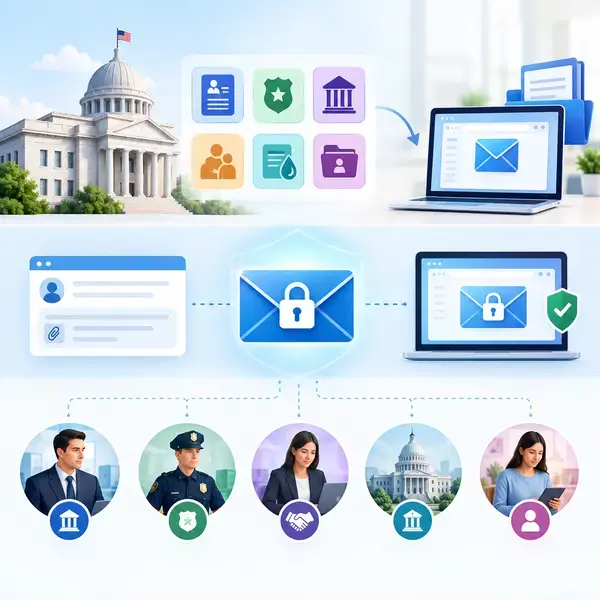
Clerks, deputies, and caseworkers keep the workflow they already know, and residents never face a registration screen. See how encrypted email delivery works from both sides of a message.
Secure Email for Law Enforcement and Court Records Sharing
Police departments, sheriff offices, district attorneys, and court clerks exchange criminal justice information by email daily, usually with agencies running entirely different systems. SafeMailer protects that exchange without asking the receiving agency to adopt anything first, because recipients verify with the Google or Microsoft account they already hold.
Case Files
Share reports and discovery with verified recipients only.
Court Records
Send filings and orders without unprotected attachments.
Dispatch Data
Protect incident records moving between jurisdictions.
Audit Trail
Record every access event for oversight and review.
State and Local Roles and the Email Controls They Need
Different offices inside the same county answer to different rules. A single blanket policy either blocks work or leaves gaps. SafeMailer applies controls per team and per message instead.
| Public Role | Data Sent by Email | Control Applied |
|---|---|---|
| Police and sheriff departments | Incident reports, discovery, criminal justice information | Encryption, identity verification, forward blocking, audit log |
| Court and county clerk offices | Filings, orders, sealed records, case correspondence | One Time View, download blocking, access revocation |
| County health departments | Patient and program data covered by a signed BAA | AES-256-GCM at rest, TLS 1.3 in transit, access logging |
| School districts | Student education records covered by FERPA | Identity verified access, sender retained controls |
| Benefits and social services | Case files, eligibility records, resident correspondence | Encryption by default, revocation after delivery |
| City and municipal IT | Procurement files, personnel records, vendor contracts | Per sender licensing, full audit trail, no install |
Agencies with framework agreements, assessment deadlines, or specific control mapping requirements can contact the SafeMailer public sector team to plan a rollout across departments.
CJIS, FERPA, and Public Records Compliance for Agencies
State and local agencies answer to more overlapping rules than most federal offices. CJIS governs criminal justice data, FERPA governs student records held by school districts, state breach notification statutes set disclosure deadlines, and open records law sets what has to be produced on request. All of it lands in the same inbox.
SafeMailer produces the security control and the compliance evidence in a single action, so the audit log that proves access control is also the record an assessor or a records officer asks to see.
Agencies handling criminal justice data can review the CJIS email compliance controls that apply to any message sent outside a physically secure location.
How SafeMailer Supports Agency Compliance
- AES-256-GCM encryption at rest, TLS 1.3 in transit
- Identity verification before any message opens
- SOC 2 Type II and ISO 27001 certified operations
- Complete audit logging of every access event
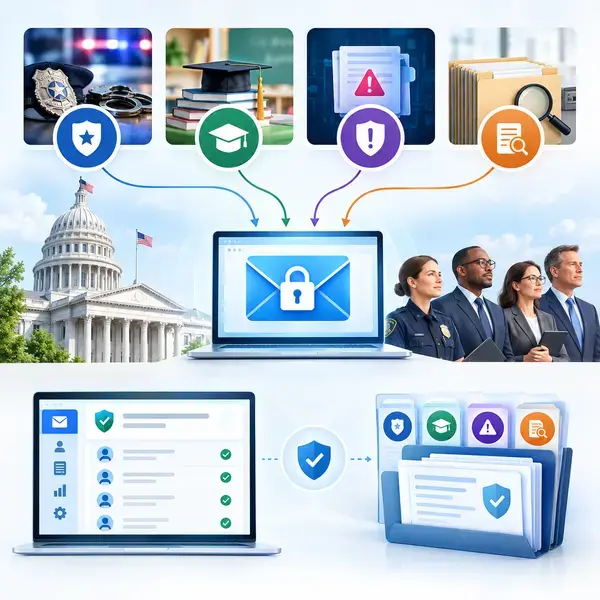
Which State and Local Teams Use SafeMailer
County Departments
Benefits, permits, and case records
City and Municipal IT
Small teams securing every department
Law Enforcement
Reports, discovery, and inter-agency files
School Districts
Student records held under FERPA rules
Health Departments
Resident health data under a signed BAA
How Local Government Email Encryption Works
SafeMailer runs in four steps, inside the mailbox staff already use.
Compose
Staff write the message in Outlook or Gmail as usual
Encrypt
AES-256-GCM applies to the message and its attachments
Verify
Recipients confirm identity with a Google or Microsoft account
Control
Senders revoke access or block forwarding at any time
Free Encrypted Email for Small Government IT Teams
Most local agencies cannot open a procurement file to test a security tool. The SafeMailer free plan removes that blocker. It includes ten encrypted emails a month, attachments up to one hundred megabytes, One Time View, and a signed business associate agreement, with no card required and no expiry date attached.
A clerk can send a protected filing, a records officer can confirm the audit trail, and an IT lead can watch a partner agency open the message before anyone drafts a purchase order. Pricing is per sender rather than per mailbox, so a department pays only for staff who actually send protected mail. Full SafeMailer plan and pricing detail is published openly.
Create Free AccountFrequently Asked Questions
Email security for state and local government agencies is the protection of public sector email through encryption, verified recipient access, sender retained controls, and audit logging, so citizen records, case files, and inter-agency messages cannot be read by unauthorised parties. Standard email falls short because transport encryption protects a message only while it moves between servers. SafeMailer applies AES-256-GCM encryption to the message itself, which means protection survives delivery.
Any agency transmitting criminal justice information outside a physically secure location must encrypt it, control who can access it, and log that access. That applies to police departments, sheriff offices, prosecutors, and court clerks sending records by email to partner jurisdictions. SafeMailer supports each of those obligations through AES-256-GCM encryption, identity-verified recipient access, sender-applied forwarding restrictions, and complete audit logging, without requiring the receiving agency to deploy matching software first.
SafeMailer runs as browser-based software inside the Microsoft Outlook and Google Gmail accounts a city already uses. There is no plugin to push to endpoints, no MX record change, no gateway to configure, and no migration. A two-person IT team grants access, and staff begin sending protected mail the same day.
Yes. Recipients at another department open a SafeMailer protected message by verifying with the Google or Microsoft account they already hold. There is no registration screen, no new password, and no software for the receiving agency to install. The sending department keeps control of the message and can block forwarding, block downloading, apply One Time View, or revoke access entirely after delivery. Every one of those events is written to an audit record the originating agency can produce later.
District staff compose in Outlook or Gmail and choose to send the message protected. SafeMailer then applies encryption and identity verification to the transcript, IEP, or disciplinary record automatically and logs every open. Districts can review the FERPA email requirements for student records that govern how those files are shared with parents, transfer schools, and contracted service providers.
No. Encryption controls who can read a message, not whether the agency retains it. SafeMailer records every send, open, and access attempt, which gives a records officer a cleaner disclosure trail than an ordinary mailbox provides. The agency still decides what is releasable and still applies its own redaction and exemption process exactly as it does today.
The right answer depends on whether the county can absorb infrastructure change. Gateway products filter inbound threats but require MX record changes and stop protecting a message once it is delivered. Government cloud tenants demand migration budget and a long procurement cycle. SafeMailer fits counties that need protection on outbound sensitive email quickly, because it runs inside existing mailboxes and can be tested at no cost.
Yes. The SafeMailer free plan includes ten encrypted emails a month, one hundred megabyte attachments, One Time View, and a signed business associate agreement, with no card and no trial expiry. Small departments routinely validate the recipient experience and the audit trail before a procurement conversation begins. Create a free SafeMailer account and send a protected message today.
Start Protecting Local Government Email Today
Counties, cities, school districts, and law enforcement agencies use SafeMailer to keep citizen data protected after it leaves the building. Send a protected message in the next few minutes on the free plan, or speak to the public sector team about department wide deployment, compliance evidence, and control mapping.