What Email Compliance Software Does for a Business
Email compliance software is a category of security tooling that helps organizations send, receive, store, and monitor email in line with legal and regulatory requirements. Instead of trusting a standard mailbox to protect confidential data, these platforms layer encryption, access control, retention, monitoring, and reporting on top of the email your team already uses.
The work usually falls into five jobs. The first is protecting content, so a message and its attachments cannot be read by anyone other than the intended recipient. The second is controlling access, which means verifying identity before someone opens a protected email and, in many cases, restricting forwarding, copying, or downloading. The third is preventing data loss by catching sensitive information before it leaves the organization by mistake. The fourth is defending against inbound threats such as phishing and impersonation. The fifth is keeping evidence, through audit trails and archives that show regulators exactly what happened and when.
A business rarely needs all five in equal measure. A healthcare provider leans on encryption and access logs. A financial firm often prioritizes supervision and retention. A defense contractor cares most about controlling who can access export controlled data. Working out which jobs matter most to you is the first real step toward picking software that fits.
Types of Email Compliance Software for Business
The phrase email compliance tool covers several distinct product categories. Grouping them makes comparison far easier and stops you from paying for capabilities you do not need.
Encryption First Email Compliance Platforms
These platforms treat encryption and recipient authentication as the foundation of compliance. Every message and attachment is encrypted in transit and at rest, and only a verified recipient can open it. This is the most direct way to satisfy rules that require protection of specific data types, such as protected health information or personal data, because the protection travels with the message rather than depending on the network.
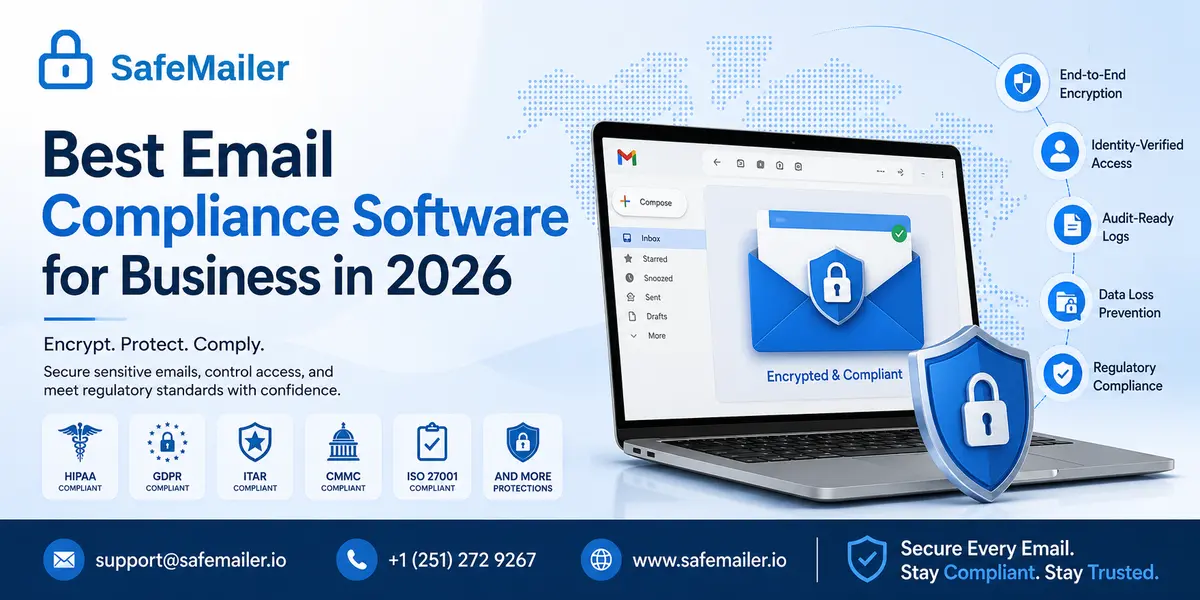
Modern encryption first tools have removed the friction that made older secure email painful. The best options work inside Gmail and Outlook, need no plugins, and let recipients authenticate with an existing Google or Microsoft account instead of creating a portal login. That combination of strong protection and low recipient effort is what makes encryption first email security software for business practical to roll out across a whole company. SafeMailer sits in this category, and its browser based email encryption removes the deployment burden that usually slows compliance projects down.
Email Archiving and Supervision Suites
Archiving and supervision suites capture every message, store it in tamper resistant form, and let compliance officers search, review, and flag communications. They are built for regulated finance, where records must be retained for years and employee messaging must be monitored for misconduct. These suites are powerful, but they solve a narrow problem. They preserve and police email; they do not, on their own, encrypt an outbound message so an external recipient can read it securely. Enterprises with heavy surveillance obligations often run a supervision suite alongside an encryption platform rather than relying on either one alone.
Secure Email Gateways and Anti Phishing Software
A secure email gateway filters inbound and outbound mail. Good anti phishing software inspects links, attachments, sender reputation, and message intent to block impersonation, business email compromise, and malware before they reach a user. Because a single successful phishing attack can trigger a reportable data breach, phishing defense is a genuine compliance control, not just a security nicety. Gateways protect the perimeter, but they do not guarantee that a legitimate message leaving your organization is encrypted, or that the right person is the one who opens it. They work best paired with encryption rather than used in isolation.
Email Data Loss Prevention Tools
Email data loss prevention, often shortened to email DLP, scans outbound messages for sensitive patterns such as card numbers, health identifiers, or confidential document markers, then blocks, quarantines, or encrypts them automatically. DLP is the safety net that catches human error, which remains the leading cause of email compliance violations. Many encryption first platforms include DLP style controls so that sensitive messages are protected by policy, rather than left to an employee remembering to click encrypt.
Core Features to Look For in an Email Compliance Tool
Once you know which category fits, evaluate the specific capabilities below. These are the features that separate a compliance grade platform from a tool that only looks the part.
- End to end encryption on messages and attachments, applied in transit and at rest, so content stays unreadable to anyone without authorization.
- Identity based recipient authentication, so a protected email opens only after the recipient proves who they are, ideally through an account they already have.
- Granular access controls such as message expiry, revocation, and limits on forwarding, printing, or downloading, which keep data protected even after delivery.
- Audit ready logging that records who accessed a message and when, giving you the documentation auditors expect to see.
- Native workflow integration with Gmail and Outlook, because a tool people find awkward is a tool people bypass, and bypassed security is the fastest route to a violation.
- Broad regulatory coverage across the frameworks your industry faces, so one platform can support several obligations at the same time.
- Low recipient friction, meaning external parties can read and reply to secure messages without installing software or managing yet another password.
How Email Compliance Software Supports Major Regulations
The real test of any platform is whether it maps to the rules you answer to. Encrypted, access controlled email supports the frameworks that regulated businesses ask about most, and the sections below show how.
Healthcare organizations use it to protect patient data and meet the HIPAA Security and Privacy Rules. Encryption of protected health information in transit and at rest, combined with detailed access logs, addresses the core safeguards regulators expect, and it keeps clinical communication moving without exposing records. A purpose built approach to HIPAA compliant email encryption lets providers, insurers, and their business associates share sensitive files inside the inbox they already use, so protection does not depend on staff switching to an unfamiliar portal every time they send a message.
Companies that handle personal data from the European Union rely on it for GDPR. Encrypting personal data and requiring recipient authentication supports the regulation demand for appropriate technical measures, and it narrows the exposure that turns a simple addressing mistake into a reportable breach. Adopting GDPR email encryption means customer and employee information stays protected on both the sending and receiving side, and only the verified recipient can view what was sent, which is exactly the standard of care the regulation was written to encourage.
Defense and aerospace suppliers depend on it to protect export controlled technical data. Restricting access to verified recipients helps prevent the unauthorized or foreign access that the rules prohibit, so engineering drawings, specifications, and military documentation stay inside an approved circle. Contractors adopt ITAR compliant email instead of sending controlled files as ordinary attachments or public links, because the protection stays attached to the message after delivery and blocks the kind of accidental disclosure that leads to serious penalties in the defense supply chain.
Contractors across that same supply chain also use it to satisfy Department of Defense cybersecurity expectations. Encrypting messages before they are delivered supports the protection of Controlled Unclassified Information that sits at the heart of CMMC and NIST 800-171 email compliance, so primes and subcontractors can exchange information across partners and agencies without falling out of scope. Because the encryption runs inside familiar email tools, teams meet the requirement without new equipment or heavy retraining, and human error, the most common cause of violations, drops sharply.
Schools, colleges, and universities protect student records the same way. Encrypting academic communication and limiting who can open it helps institutions demonstrate the safeguards that education privacy law requires. A dedicated option for FERPA compliant email for student records fits the way school staff already work in Outlook and Gmail, so administrators, faculty, and registrars can share transcripts, disciplinary files, and personal details securely, while access to that data is tracked for accountability during a review.
Financial institutions apply it to customer data covered by a stack of overlapping rules. Encrypted account statements, wire instructions, and audit files support obligations under the Gramm Leach Bliley Act, Sarbanes Oxley, the Payment Card Industry standard, and FINRA communication rules. A single approach to financial email compliance and encryption reduces the number of separate tools a firm has to buy, integrate, and audit, and it gives compliance teams consistent evidence across every framework they report against rather than a patchwork of point solutions.
Organizations building a formal security program use it to strengthen their information security management system. Enforcing encryption inside normal email workflow supports the confidentiality and integrity objectives behind ISO 27001 email security controls, and it produces the kind of enforceable, documented control that assessors look for during certification. Because security becomes a property of the system rather than a matter of employee behavior, the organization can show that sensitive email is protected by design, not by good intentions.
Businesses covered by the updated FTC Safeguards Rule protect customer financial information with the same controls, and public sector bodies extend them to citizen data and mission communications. Teams that want the full picture can review how one platform covers many frameworks at once through a unified email compliance approach, which is often more manageable than stitching together a different tool for every regulation.
SafeMailer as an Encryption First Email Compliance Solution
For businesses whose main compliance risk is sensitive data leaving the inbox, SafeMailer is built for exactly that job. It encrypts every message and attachment from the moment it is sent until a verified recipient opens it, and it does this inside the email tools your team already uses. There is nothing to install, no portal for recipients, and no new password to manage. Anyone with a Google or Microsoft account can receive and reply securely, even without a SafeMailer subscription.
That design solves the problem that sinks most compliance rollouts, which is adoption. When encryption is a single action inside Gmail or Outlook, people actually use it, and security stops depending on whether an employee remembers to protect a message. Compliance and security teams get message expiry, revocation, identity based access, and audit ready logs, while pricing stays predictable through a per sender model rather than a charge for every seat. For organizations that need secure business communication without adding IT overhead, that balance is the whole point.
SafeMailer supports the frameworks regulated businesses face most, including HIPAA, GDPR, ITAR, CMMC, FERPA, ISO 27001, GLBA, SOX, PCI, and the FTC Safeguards Rule, all from one platform. The fastest way to see whether it fits your workflow is to start with a free SafeMailer account and send your first encrypted, audit ready message today.
How to Choose the Right Email Compliance Software
A structured shortlist beats a feature checklist. Work through these steps in order and let your obligations, not a vendor pitch, drive the decision.
- Map your obligations first. List the regulations you must meet and the exact data types you handle. Your legal requirements should shape the shortlist before any product does.
- Match the tool type to your primary risk. If confidential data leaving the inbox is the biggest exposure, an encryption first platform fits. If retaining and policing internal messaging is the priority, a supervision suite fits. Most businesses need protection more than surveillance.
- Weigh recipient experience heavily. Encryption that forces external contacts through portals and password resets gets abandoned within weeks. Tools that let recipients authenticate with accounts they already own see far higher adoption, which is what keeps a program compliant in practice. Public sector teams evaluating email security for government agencies should hold vendors to the same recipient friction test.
- Check deployment cost, not just license cost. Enterprise suites often carry long rollouts, admin training, and custom quotes. A platform that runs inside existing inboxes with no plugins removes most of that hidden overhead.
- Confirm the audit trail. Whatever you choose has to produce clear records of who accessed what and when, because during an audit, evidence is the only thing that counts.
Email Compliance Mistakes That Create Regulatory Risk
Most compliance failures are not caused by missing software. They are caused by the wrong assumptions about what that software does. Avoid these common errors.
- Treating archiving as complete compliance. Retaining messages does not protect the ones you send. Without encryption and access control, sensitive outbound email is still fully exposed.
- Relying on employees to remember to encrypt. Manual protection fails at scale. Policy-based or single-action encryption removes the human error behind most violations.
- Ignoring the recipient side. If external partners cannot open a secure message easily, staff quietly revert to unprotected email, and the whole program collapses.
- Buying enterprise complexity you will never use. Oversized surveillance platforms can drain budget and stall for months while simpler, more urgent risks go unaddressed.
- Forgetting inbound threats. Encryption protects outbound data, but without anti-phishing defence, one inbound attack can still cause a reportable breach.
Frequently Asked Questions
What is email compliance software?
Email compliance software is a set of tools that help a business send, store, and monitor email in line with legal and regulatory requirements. It usually layers in encryption, recipient verification , access safeguards, data loss prevention , and audit trails on top of regular email, so the confidential information stays guarded and each action is recorded for an audit.
Is email encryption required for compliance?
Most data protection regulations do not name a specific product, but they do require appropriate safeguards for sensitive information. Encryption is the most widely accepted way to meet that bar for email, because it keeps messages and attachments unreadable to anyone who is not authorized, both while they travel and while they are stored.
What is the best email compliance software for a small business?
The best fit for a small business is usually an encryption first platform that works inside Gmail or Outlook, needs no IT deployment, and lets recipients open secure messages without extra software. This keeps compliance affordable and easy to adopt. SafeMailer is designed for this use case, with a free plan and simple per sender pricing.
Does email compliance software stop phishing?
Some of it does. Anti phishing software and secure email gateways inspect inbound messages for malicious links, attachments, and impersonation. Encryption first platforms focus instead on protecting the data you send, so many organizations combine both approaches to cover inbound threats and outbound protection together.
How does email compliance software help with HIPAA?
For HIPAA, the software encrypts protected health information in transit and at rest, verifies recipient identity before a message can be opened, and records access in audit logs. Together these controls address the Security Rule safeguards that regulators expect for electronic patient communication.
How much does email compliance software cost?
Pricing ranges widely. Enterprise archiving and supervision suites often start in the tens of thousands of dollars per year with custom quotes. Encryption first platforms are far more accessible. SafeMailer, for example, offers a free plan and paid tiers on a per sender basis, so cost scales with the number of people sending secure email rather than every seat in the company.
Can email compliance software work with Gmail and Outlook?
Yes. The most practical tools operate inside Gmail and Outlook so staff keep their normal workflow. SafeMailer runs in the browser with no plugins, and recipients authenticate with their existing Google or Microsoft account to read and reply securely, which is what makes company wide adoption realistic.
The Bottom Line on Email Compliance Software for 2026
Email remains the highest volume channel for sensitive business data, and the regulations governing it are only getting stricter. The right email compliance software protects that data, controls who can see it, and gives you the records to prove it, all without slowing your team down. For most regulated businesses, an encryption first platform delivers that balance better than a heavier enterprise suite. To see how it works in your own inbox, create your free SafeMailer account and send a compliant, encrypted message in minutes.