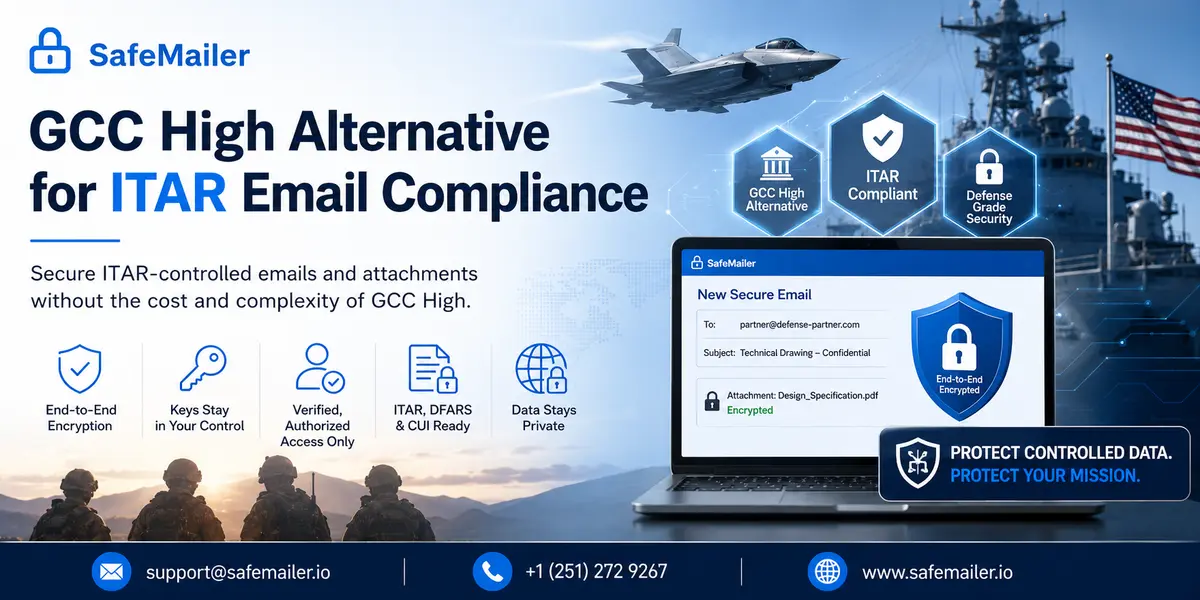
This guide shows where GCC High is genuinely required, where a focused encryption layer covers the email and attachment workflow at a fraction of the cost, and how SafeMailer lets defense teams protect ITAR compliant email inside the Gmail and Outlook accounts they already use. It is written for compliance leads, security engineers, and program managers who need a decision they can defend, not a lecture.
The Real Cost of Microsoft GCC High for Defense Contractors
GCC High is Microsoft government cloud built for the Defense Industrial Base. It runs on Azure Government, keeps data inside the continental United States, restricts operations staff to screened United States persons, and carries a contractual commitment to ITAR and DFARS obligations. That last point is the reason it exists, because it is the only Microsoft 365 environment where Microsoft will sign ITAR contract language.
The trade is cost and effort. Contractors moving to GCC High usually face several real burdens:
- A per user license premium that can run several times the price of a commercial or standard GCC seat.
- A tenant migration project measured in months, with mailbox, SharePoint, and Teams cutover to plan and test.
- Slower feature timelines, since GCC High trails the commercial cloud on new releases.
- Recipient friction, because external partners who sit outside your tenant still need a way to open protected messages.
- Ongoing management of a separate sovereign environment that most of your non defense work never touches.
Many teams answer this with an enclave approach, running a small GCC High tenant for the defense work and a commercial tenant for everything else. That keeps spend closer to the real footprint, but it leaves the same open question for email. How do you protect a controlled message the moment it leaves your boundary and lands in a partner inbox you do not control.
GCC High Alternative for ITAR Compliant Email
The gap most GCC High projects miss is that email is where controlled technical data actually moves and actually leaks. Drawings, specifications, and CAD files travel as attachments every working day, and a single misaddressed message can put that data in front of an unauthorized recipient. Securing the tenant does nothing once the message is sitting in someone else inbox.
This is where a data centric encryption layer earns its place as a GCC High alternative for the email workflow. Rather than relying on where the servers sit, it protects the message and its attachments so that only verified, authorized recipients can decrypt them. The provider cannot read the content, forwarding can be restricted, and access can be revoked after the message is sent. For the email and attachment part of an ITAR program, that control is the thing the regulation actually cares about.
You can apply that protection without uprooting your environment. Teams keep working inside the accounts they already use, and encryption runs underneath. For a large share of contractors, that is enough to close the email exposure a tenant migration never addresses, and it pairs cleanly with dedicated email security for defense contractors when a program needs deeper coverage.
ITAR Email Encryption Requirements Under the 120.54 Carve Out
ITAR does not name a single product. It sets a control objective and, since 2020, gives a clear path to meet it for data in transit and storage. Under 22 CFR 120.54, sending or storing unclassified technical data is not treated as an export when the data is secured with end to end encryption and the decryption keys never reach an unauthorized person.
Two conditions decide whether an email approach qualifies:
- Encryption strength at least equal to the Advanced Encryption Standard, with AES 256 the common choice, as federal guidance moves from FIPS 140-2 to FIPS 140-3 validation while older approvals retire.
- Keys held so that no unauthorized party, including the email provider, can decrypt the message.
The related rule to keep in view is the deemed export standard in 22 CFR 120.50, where releasing controlled technical data to a foreign person, even inside the United States, counts as an export. That is why unauthorized access to a message matters as much as where it is stored, and why identity verified access sits at the center of a compliant design. You can see the sending and opening steps in how SafeMailer works to judge the workflow for yourself.
CUI and DFARS 7012 Email Security for the Defense Industrial Base
Most ITAR contractors carry overlapping obligations. If your contracts include DFARS 252.204-7012, any cloud service that stores, processes, or transmits covered defense information has to meet at least the FedRAMP Moderate baseline, and you have to report cyber incidents to the Department of Defense within 72 hours. On top of that, CMMC Level 2 expects all 110 controls in NIST SP 800-171, several of which land squarely on email, including access control, identification and authentication, audit and accountability, and system and communications protection.
Encryption that protects controlled unclassified information in email and its attachments supports those controls directly. It restricts access to authorized users, produces the access trail an assessor asks for, and keeps CUI protected end to end rather than only while it crosses the network. It does not replace your compliance program, but it removes one of the largest and most common sources of exposure in the assessment scope, which is why it fits neatly alongside your CMMC and DFARS email compliance work.
GCC High and Email Encryption Layer Compared
The two approaches solve different parts of the problem. GCC High secures the whole Microsoft tenant. An encryption layer secures the message and the file. Most mature programs use both, scoped so each covers what it does best.
| Consideration | Microsoft GCC High | Email encryption layer |
|---|---|---|
| What it protects | Entire Microsoft 365 tenant, mailbox, SharePoint, Teams, OneDrive | The message and its attachments, end to end |
| ITAR technical data storage | Yes, sovereign United States person environment | Complements storage controls at the message level |
| United States person access | Enforced at the platform level | Enforced per message through verified recipient identity |
| Cost model | Per user premium across the whole tenant | Per sender, scoped to who actually sends controlled email |
| Deployment | Multi month tenant migration | Works inside existing Gmail and Outlook, no migration |
| External recipient experience | Recipient is often outside your tenant | Recipient verifies with a Google or Microsoft account, no new portal |
| Best fit | Storing and processing ITAR and CUI at the tenant level | Closing email and attachment exposure quickly and affordably |
Read together, the table points to a simple planning rule. Use GCC High where controlled data has to live inside the tenant, and use a focused encryption layer to lock down the email path that leaks data regardless of where the tenant sits. The same logic applies across a supply chain, which is why aerospace email security programs lean on message level protection for partner collaboration.
When Defense Contractors Still Need GCC High
Being honest about this is part of getting it right, and it protects you from an expensive mistake in either direction. GCC High remains the required foundation in specific cases:
- ITAR or EAR controlled technical data has to be stored and processed inside your Microsoft 365 tenant, not only sent by email.
- A contract explicitly requires a Department of Defense Impact Level 4 or 5 cloud environment for collaboration tools.
- Your program needs Microsoft contractual ITAR commitment for the underlying platform, which commercial and standard GCC do not provide.
The costly errors are over scoping and under scoping. Paying the GCC High premium for standard CUI that never needed it wastes budget. Leaving export controlled data in a commercial tenant because no one flagged it as ITAR fails an assessment and forces a rushed migration later. The right move is to classify controlled data first, put GCC High where storage demands it, and use an encryption layer across the whole program, alongside your wider email compliance solutions.
SafeMailer for ITAR and CUI Email Security
SafeMailer is a browser based email encryption platform built for the email and attachment layer that most tenant projects leave exposed. It gives defense, aerospace, and government teams a fast, affordable way to protect controlled technical data without a migration and without asking recipients to install anything.
What SafeMailer provides:
- AES-256-GCM message encryption applied before a message leaves your environment, on the body and every attachment.
- Identity verified access, so only authorized recipients can open a message, with the ability to block domains and revoke access.
- Access tracking and audit logs that show when a message was opened and by whom, ready for an internal review or a DDTC inquiry.
- Secure file sharing for the drawings, CAD files, specifications, and manuals that carry the most risk, covered in detail in our guide to send sensitive files securely.
- Native Gmail and Outlook use, so engineers and program staff keep the inbox they already know.
- Per sender pricing, so you pay for the people who actually send controlled email rather than every seat.
Secure Controlled Technical Data in Gmail and Outlook
The workflow is deliberately ordinary, because most export control incidents come from a manual step someone forgets. A sender composes a message as usual. SafeMailer encrypts it and its attachments as it is sent. The recipient gets a standard email, verifies their identity through an existing Google or Microsoft account, and reads or replies with full encryption. Nothing is installed, no portal account is created, and protection stays with the file after it lands rather than ending at the inbox.
That is what makes the control durable across a supply chain. Primes, subcontractors, engineering firms, and research teams can exchange controlled data without every party standing up a sovereign tenant, and security leads keep the access trail they need to prove authorized handling. The result is real coverage of the email risk at a cost that matches the actual footprint.
Get Started With ITAR Compliant Email
You can validate the workflow before committing budget. Create a free SafeMailer account, send an encrypted ITAR message in minutes, and scale as your program grows. Compliance and security leads get to test real controlled data handling first, which is usually the fastest route to a confident decision. Review the SafeMailer pricing to see how per sender plans keep spend aligned with your controlled email footprint.
Start free with SafeMailer and protect controlled technical data today, with no credit card and no installation required.
Frequently Asked Questions
Do you need GCC High for ITAR email?
Not always. GCC High is required when ITAR controlled data has to be stored and processed inside your Microsoft tenant, or when a contract demands an Impact Level 4 or 5 environment. For the email and attachment workflow, the 22 CFR 120.54 carve out lets you rely on end to end encryption where the provider cannot decrypt, which protects controlled messages without a full tenant migration.
Is email encryption enough for ITAR compliance on its own?
Encryption covers the transmission and storage of controlled data in email, which is a major part of the exposure, but ITAR compliance is broader. You still need a technology control plan, documented access controls, and handling procedures. Encryption closes the email gap and supports those controls rather than replacing the wider program.
Can defense contractors use Gmail or Outlook for CUI email?
Yes, when the controlled content is protected with end to end encryption and access is limited to verified, authorized recipients. SafeMailer runs inside Gmail and Outlook, so teams keep their normal workflow while encryption, identity verification, and audit logging happen underneath.
What encryption standard does ITAR email require?
The carve out expects strength at least equal to the Advanced Encryption Standard, with keys kept from any unauthorized person. AES 256 is the common choice, and federal cryptographic references are moving from FIPS 140-2 to FIPS 140-3 as older validations retire, so a current end to end approach keeps you aligned as the standard shifts.
How does SafeMailer reduce GCC High cost?
SafeMailer secures the email and attachment layer on a per sender basis, so you protect controlled communication without licensing an entire sovereign tenant for every seat. Where GCC High is still required for storage, SafeMailer scopes the email exposure so environment spend matches your real controlled data footprint.
How does SafeMailer compare to other GCC High alternatives for email?
SafeMailer focuses on the email and attachment workflow with a browser based design, no plugins, and no recipient portal. Recipients verify with an existing Google or Microsoft account, which removes the extra accounts and password resets that slow down many alternatives, while still enforcing encryption, identity based access, and audit logging.