Why Perimeter Security No Longer Protects Your Data
Picture a company that has invested heavily in firewalls and network defenses. On paper, everything looks protected. Then an employee attaches a confidential contract to an email and sends it to the wrong address. No firewall stops it. No perimeter tool flags it. The data is simply gone.
That gap is the whole problem with traditional security. It guards systems and networks, but the thing attackers and plain accidents actually expose is the data. And data no longer sits behind a single wall. It moves across cloud platforms, personal devices, contractors, and email threads every hour of the day. Once the asset you care about is always in motion, protecting only the places it used to live stops doing the job.
That is why data centric security has gone from a niche idea to a mainstream strategy. Rather than asking where the data lives, it asks who is touching the data, how they are using it, and whether that should be allowed at all.
What Is Data Centric Security
Data centric security applies protection directly to the information instead of to the walls around it. The controls stay glued to the data through its entire life, in storage, in transit, and while it is being shared. Three questions sit at the heart of the model.
- Who is requesting access to this data
- How is the data being used once access is granted
- Should this specific access be allowed right now
Because the answers travel with the file, the data stays protected even when it lands somewhere the organization does not control, like a partner's inbox or a personal laptop.
Data-centric security and information-centric security
Information-centric security is a close cousin, and the two often run side by side. The difference is emphasis. Information-centric security sorts data by sensitivity and value, then applies protection in proportion to that classification. In practice they reinforce each other. Classification decides how hard something needs to be protected, and data centric controls enforce that protection wherever the information ends up.
| Model | Core Focus |
|---|---|
| Perimeter security | Protecting networks and systems at the boundary |
| Data centric security | Protecting the data itself wherever it travels |
| Information centric security | Protecting data according to its sensitivity and value |
| Zero trust data protection | Verifying every access request before granting it |
How Zero Trust Data Protection Strengthens the Model
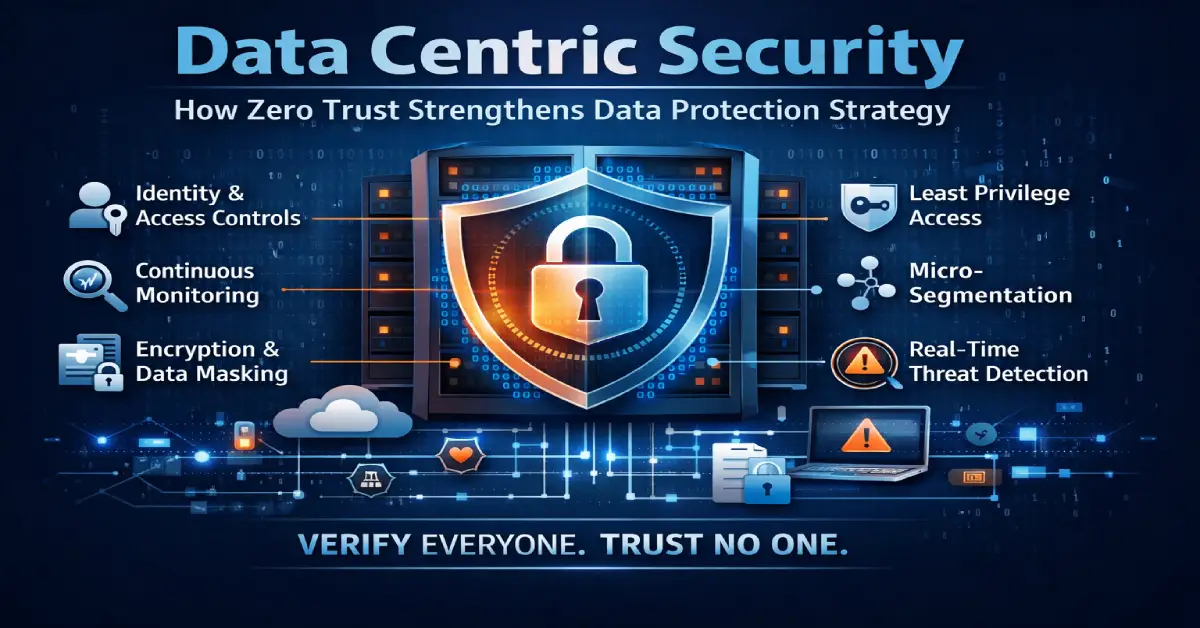
Zero trust data protection runs on one principle. Never trust, always verify. Every access request is validated before permission is granted, even when it comes from inside the organization. This removes the dangerous assumption that internal users are automatically safe, which is the assumption most insider incidents exploit.
The zero trust principles that matter most for data centric security are straightforward.
- Identity based access control for every request
- Continuous verification rather than one time login trust
- Least privilege, so users get only the access they truly need
- Monitoring of every data interaction for visibility
Email is where zero trust and data centric thinking meet most often, because email is where data leaves the building. The zero trust email security guide explains how identity verification and encryption apply these principles to everyday business communication.
A Real World Scenario That Shows Why It Matters
Take a healthcare provider sharing patient records with an outside billing partner. Under a perimeter model, those records are safe only while they sit on internal servers. The instant they are emailed out, the protection drops away and the data is exposed to whatever comes next.
Switch to a data centric approach and the ending changes. The records are encrypted, access is held to authorized users, activity is watched, and unauthorized sharing is blocked. Even if the file is intercepted along the way, it stays unreadable to anyone without authorized access. The protection did not stop at the network edge. It went with the data.
Key Benefits of Data Centric Security for Businesses
| Benefit | What It Means in Practice |
|---|---|
| Continuous data protection | Sensitive data stays protected in storage, transit, and sharing |
| Reduced breach risk | Intercepted or misdirected data remains unreadable |
| Stronger compliance posture | Encryption and access logs support regulatory requirements |
| Better visibility | Teams see how data is accessed and used |
| Tighter control over sharing | External sharing happens on the organization's terms |
The Role of Secure Email in a Data Centric Strategy
Email is the most common way sensitive data gets shared, and when it is left unsecured, it is also the most common way that data leaks out. That puts secure email at the foundation of any data centric security strategy. The capabilities that count are encryption of the message body and its attachments, secure file sharing for sensitive documents, access control on every message, and monitoring of email activity.
SafeMailer brings these controls into Gmail and Outlook so protection follows the message after it is sent. For practical workflows, the guide to sending sensitive files securely covers DLP, watermarking, and encryption in detail.
How SafeMailer Supports Data Centric Security
SafeMailer is built to protect sensitive communication in modern business environments, where data moves constantly and the network edge no longer contains it.
- Encrypted email helps keep data protected during the actual transmission process
- Secure file sharing stops unwanted viewers from touching attachments
- Communication monitoring offers a clearer view of how data is used
- Compliance ready controls back up regulatory expectations
Industries That Depend on Data Centric Security
| Industry | What They Protect |
|---|---|
| Healthcare | Patient records and protected health information |
| Financial services | Account data and financial records |
| Government and defense | Confidential and controlled information |
| Education | Student records and personal data |
These fields use data-centric security to fulfil legal obligations and also to safeguard sensitive information. The HIPAA compliant email encryption page covers healthcare-specific requirements, and the full compliance overview maps SafeMailer to other frameworks.
Best Practices for Implementing Data Centric Security
- Identify and classify sensitive data so you know what you have and how sensitive it is before applying protection.
- Encrypt every critical piece of information in storage and during transit, plus while it is being shared.
- Use identity-based access control so data is limited to verified users and their roles, not just anyone with “some access”.
- Monitor data access and also data sharing activity to keep a steady picture across the whole organization, including the parts that “nobody checks much”.
- Train staff on secure communication so people handle sensitive data responsibly.
Frequently Asked Questions
What is data centric security?
Data centric security, in short, is an approach where the data is guarded directly through encryption, access restrictions and monitoring, so it stays protected regardless of whether it is stored locally or shared elsewhere, even outside your control. The protection rides along with the data instead of depending on network boundaries.
What is zero trust data protection?
Zero trust data protection checks each access request, and it assumes no user is automatically trusted, including the people “inside” the org. When you pair that with data centric controls, the sensitive information stays protected at every access point, not just some of them.
How is data centric security different from traditional security?
Traditional security guards networks and systems at the perimeter. Data centric security guards the data itself wherever it travels, which matters now that data is constantly on the move across cloud platforms, devices, and email.
Why is data centric security important for businesses?
It reduces the chance of data breach, supports regulatory compliance, and helps protect sensitive information across cloud systems and even across communication channels, more or less. Even if the data gets intercepted, it should remain unreadable for anyone without authorization.
How does secure email support data centric security?
Secure email encrypts communication, controls access, monitors activity, and stops sensitive data from being shared without authorization. Since email is the most common sharing channel, locking it down is a core part of any data centric strategy.